
If you've ever seen an old, damaged photo suddenly become clear and detailed again, it can feel almost unbelievable.
Scratches disappear. Faces become sharper. Details that seemed lost come back into focus.
It might look like magic — but there's actually a clear reason why this is now possible.
From Manual Work to Instant Results
Not long ago, restoring a photo was a slow, manual process.
Professionals would spend hours using tools like Photoshop to:
- carefully remove scratches
- rebuild missing areas
- adjust contrast and sharpness
It required both technical skill and a lot of time.
Today, AI has completely changed that.
What used to take hours can now happen in seconds.
What AI Actually Does
At a simple level, AI photo restoration works by learning patterns from millions of images.
Instead of just “editing” a photo, it understands what should be there.
For example, it can recognize:
- what a human face should look like
- how textures like skin, hair, or fabric behave
- how light and contrast normally appear
Using this knowledge, it can rebuild parts of an image that are faded, damaged, or unclear.
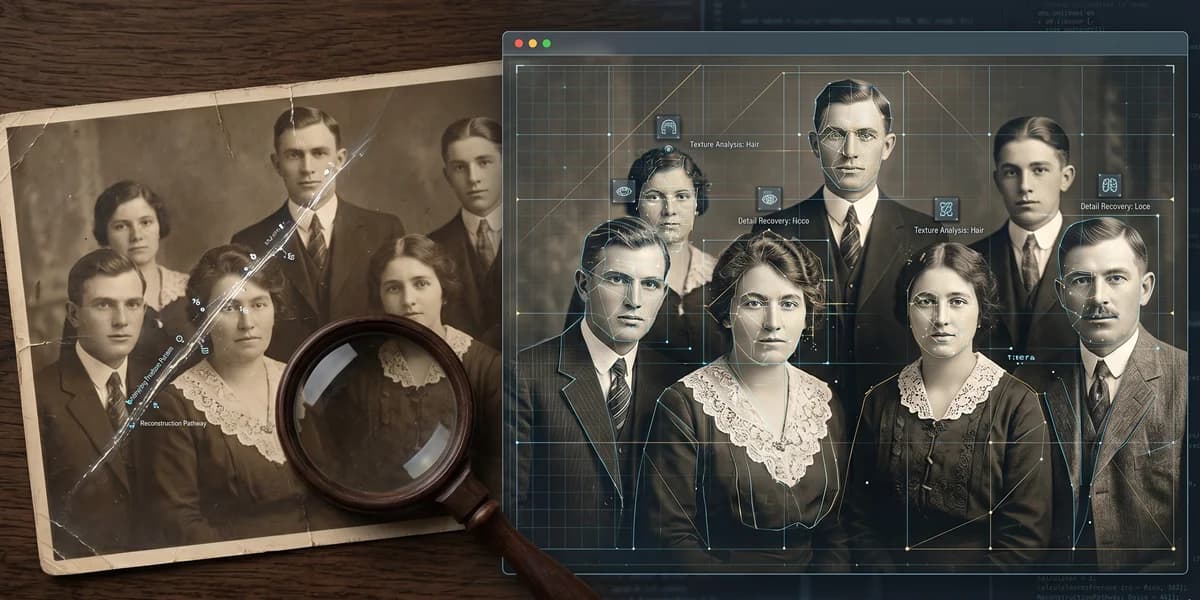
Don't let your memories fade away
The Three Main Things AI Improves
1. Restoring Lost Details
When a photo fades, it loses contrast and fine detail.
AI can analyze what remains and reconstruct missing information — making faces, objects, and backgrounds clearer.
2. Removing Damage
Scratches, dust, and marks are common in old photos.
AI can detect these imperfections and remove them automatically, blending the repaired areas naturally into the image.
3. Enhancing Clarity
Blurry or soft images can often be sharpened.
AI improves clarity by refining edges and textures, helping the photo look closer to how it might have originally appeared.
Why Results Feel So Natural
One of the biggest concerns people have is:
“Will it still look like the original?”
Modern AI doesn't just apply generic filters. It tries to preserve the character of the photo while improving its quality.
That means:
- facial expressions stay recognizable
- proportions remain consistent
- the overall “feel” of the image is maintained
The goal isn't to change the photo — it's to reveal it.
Your Memories Are Yours Alone
We know that family photos are deeply personal. A common concern with AI today is whether your data is being used to “train” the system. With our service, the answer is a firm no.
- No Training: Your photos are never used to train our AI models or shared with third parties for development.
- Full Ownership: You retain 100% of the rights to your original and restored images.
- Privacy First: Your photos are processed securely, and we don't keep them on our servers longer than necessary to provide your restoration.
We treat your family history with the same respect you do. Our goal isn't to own your memories — it's simply to help you see them clearly again.
What AI Can't Do (Yet)
While AI is powerful, it's not perfect.
There are limits, especially when:
- large parts of the image are missing
- faces are extremely blurred
- the original photo is very low resolution
In these cases, results can still improve — but may not be fully accurate.
Being aware of this helps set realistic expectations.
Why This Matters Now
The biggest shift isn't just quality — it's accessibility.
You no longer need:
- advanced editing skills
- expensive software
- hours of manual work
Anyone can restore a photo with just a few clicks.
From Complex to Simple
What used to be a specialized skill is now something you can try instantly.
You can take a photo that's been sitting in a box for years, upload it, and see a restored version in seconds.
No setup. No learning curve.
Just a simple way to bring back something that matters.
A Simple Way to Try It
If you're curious how your own photos might look restored, you don't need to commit to anything.
When we launch, you'll be able to upload a photo and see the transformation in real-time. Join our waitlist now to get early access to our ‘Instant Preview’ feature.
Sometimes, seeing that transformation is all it takes.